







From Stability to Growth: Precision Strategies for Revenue Generation and Expenditure Control




From Stability to Growth: Precision Strategies for Revenue Generation and Expenditure Control

In the 2024/25 Financial Year, the Government recorded a deficit of HK$80.3 billion for its Consolidated Account, drawing widespread public attention to the state of public finances. Benefiting from several large-scale initial public offerings (IPOs), a substantial increase in stock market turnover, and a gradual stabilization in property market transactions, the financial sector, real estate market, and the real economy have all improved in tandem. This has led to a notable rebound in tax revenues, providing an important buffer for Hong Kong’s public finances.
Although the Government has forecast that the Operating Account will return to a surplus, Hong Kong must remain vigilant and adopt a long-term perspective to strengthen the foundations of our public finances. This is necessitated by the growth in expenditures driven by an aging population and major infrastructure projects, combined with the fact that emerging industries and new market developments take time to translate into tangible fiscal revenues.
In response, Our Hong Kong Foundation (OHKF) presents "From Stability to Growth: Precision Strategies for Revenue Generation and Expenditure Control". This latest research puts forward 18 recommendations centered on three key areas: fiscal discipline, revenue generation, and expenditure control. We believe that with prudent financial management and strategic investment in the future, Hong Kong will strengthen its fiscal resilience and pave the way for long-term prosperity.
Upholding the Basic Law’s Principle of Keeping the Expenditure within the Limits of Revenues to Re-establish Long-term Fiscal Discipline
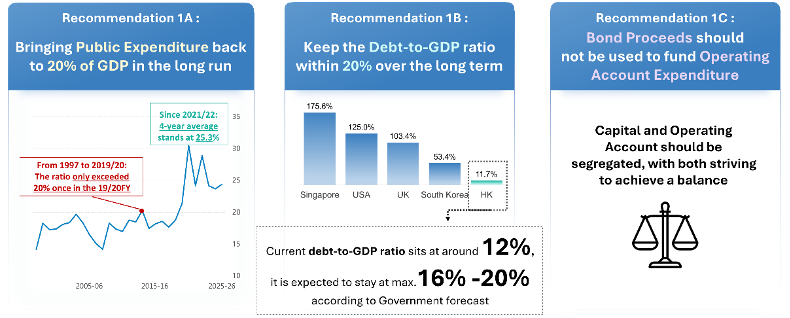
OHKF recommends a comprehensive review and modernisation of the series of fiscal disciplines proposed in 2014 report by the Working Group on Long-Term Fiscal Planning. In light of the current economic environment, it is recommended that the Government aims to reduce the public expenditure-to-GDP ratio back to 20% or below in the long run, and maintain the debt-to-GDP ratio at 20% or below over the long term. Simultaneously, the Government should continue to adhere to the principle that proceeds from bond issuance are exclusively allocated to long-term investment projects, and must not be used to cover operating account expenditures, thereby preserving a healthy fiscal structure.
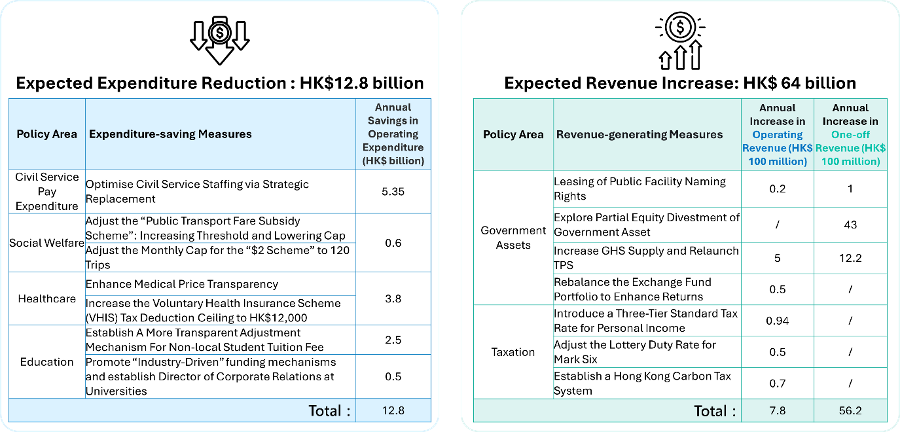
To achieve the aforementioned fiscal disciplines, OHKF proposes ‘Eight Measures to Increase Revenue’ and ‘Nine Ways to Reduce Expenditure’. All recommendations have been carefully assessed, with each measure expected to yield benefits of HK$500 million or more. These initiatives aim to expand fiscal space while minimising impacts on citizens’ livelihood and avoiding complex administrative procedures. Full implementation of the measures is projected to generate approximately HK$64 billion in additional revenue for the Government (comprising HK$56.2 billion in one-off income and HK$7.8 billion in recurrent income), alongside savings of around HK$12.8 billion in expenditure.
‘Eight Measures to Increase Revenue’ Include:
Leasing of Public Facility Naming Rights
Explore Partial Equity Divestment of Government Asset
Increase the Proportion of Green Form Subsidised Home (GSH) Units and Relaunch the Tenants Purchase Scheme (TPS)
Rebalance the Exchange Fund Portfolio - Increase the Ratio of “Long-Term Growth Portfolio” to “Investment Portfolio” from 28:72 to 40:60 to Enhance Returns
Introduce a Three-Tier Standard Tax Rate for Personal Income
Adjust the Lottery Duty Rate for Mark Six
Consider Establishing a Hong Kong Carbon Tax System, Inviting Two Power Companies to Collect from Commercial Users on Behalf of the Government
Rebalance the Short, Medium, and Long-Term Debt Mix to a Target of 3:4:3 to Align with Hong Kong’s Overall Development Needs
‘Nine Ways to Reduce Expenditure’ Include:
Optimise Civil Service Staffing via Strategic Replacement
Assist Government Departments in Leveraging AI To Enhance Efficiency through Funding, Training and Planning
Reform the Civil Service Salary Mechanism with Performance-Based Incentives
Adjust the “Public Transport Fare Subsidy Scheme”: Increasing Threshold and Lowering Cap
Adjust the Monthly Cap for the “$2 Scheme” to 120 Trips
Enhance Medical Price Transparency to Facilitate Public-Private Diversion
Increase the Voluntary Health Insurance Scheme (VHIS) Tax Deduction Ceiling to HK$12,000
After the 2026/27 Academic Year, Adjustment for Non-local Undergraduate Tuition Fees Should Follow the “Composite CPI + 2%” Formula
Review Existing Research Funding or Allocation Mechanisms to Incorporate More “Industry-Driven” Elements into the Existing “Academic-Led” System
The above policy recommendations aim to strengthen the position of public finance through a multi-pronged approach, with the goal of laying out a clear and pragmatic pathway for Hong Kong to achieve fiscal sustainability




In the 2024/25 Financial Year, the Government recorded a deficit of HK$80.3 billion for its Consolidated Account, drawing widespread public attention to the state of public finances. Benefiting from several large-scale initial public offerings (IPOs), a substantial increase in stock market turnover, and a gradual stabilization in property market transactions, the financial sector, real estate market, and the real economy have all improved in tandem. This has led to a notable rebound in tax revenues, providing an important buffer for Hong Kong’s public finances.
Although the Government has forecast that the Operating Account will return to a surplus, Hong Kong must remain vigilant and adopt a long-term perspective to strengthen the foundations of our public finances. This is necessitated by the growth in expenditures driven by an aging population and major infrastructure projects, combined with the fact that emerging industries and new market developments take time to translate into tangible fiscal revenues.
In response, Our Hong Kong Foundation (OHKF) presents "From Stability to Growth: Precision Strategies for Revenue Generation and Expenditure Control". This latest research puts forward 18 recommendations centered on three key areas: fiscal discipline, revenue generation, and expenditure control. We believe that with prudent financial management and strategic investment in the future, Hong Kong will strengthen its fiscal resilience and pave the way for long-term prosperity.
Upholding the Basic Law’s Principle of Keeping the Expenditure within the Limits of Revenues to Re-establish Long-term Fiscal Discipline
OHKF recommends a comprehensive review and modernisation of the series of fiscal disciplines proposed in 2014 report by the Working Group on Long-Term Fiscal Planning. In light of the current economic environment, it is recommended that the Government aims to reduce the public expenditure-to-GDP ratio back to 20% or below in the long run, and maintain the debt-to-GDP ratio at 20% or below over the long term. Simultaneously, the Government should continue to adhere to the principle that proceeds from bond issuance are exclusively allocated to long-term investment projects, and must not be used to cover operating account expenditures, thereby preserving a healthy fiscal structure.
To achieve the aforementioned fiscal disciplines, OHKF proposes ‘Eight Measures to Increase Revenue’ and ‘Nine Ways to Reduce Expenditure’. All recommendations have been carefully assessed, with each measure expected to yield benefits of HK$500 million or more. These initiatives aim to expand fiscal space while minimising impacts on citizens’ livelihood and avoiding complex administrative procedures. Full implementation of the measures is projected to generate approximately HK$64 billion in additional revenue for the Government (comprising HK$56.2 billion in one-off income and HK$7.8 billion in recurrent income), alongside savings of around HK$12.8 billion in expenditure.
‘Eight Measures to Increase Revenue’ Include:
Leasing of Public Facility Naming Rights
Explore Partial Equity Divestment of Government Asset
Increase the Proportion of Green Form Subsidised Home (GSH) Units and Relaunch the Tenants Purchase Scheme (TPS)
Rebalance the Exchange Fund Portfolio - Increase the Ratio of “Long-Term Growth Portfolio” to “Investment Portfolio” from 28:72 to 40:60 to Enhance Returns
Introduce a Three-Tier Standard Tax Rate for Personal Income
Adjust the Lottery Duty Rate for Mark Six
Consider Establishing a Hong Kong Carbon Tax System, Inviting Two Power Companies to Collect from Commercial Users on Behalf of the Government
Rebalance the Short, Medium, and Long-Term Debt Mix to a Target of 3:4:3 to Align with Hong Kong’s Overall Development Needs
‘Nine Ways to Reduce Expenditure’ Include:
Optimise Civil Service Staffing via Strategic Replacement
Assist Government Departments in Leveraging AI To Enhance Efficiency through Funding, Training and Planning
Reform the Civil Service Salary Mechanism with Performance-Based Incentives
Adjust the “Public Transport Fare Subsidy Scheme”: Increasing Threshold and Lowering Cap
Adjust the Monthly Cap for the “$2 Scheme” to 120 Trips
Enhance Medical Price Transparency to Facilitate Public-Private Diversion
Increase the Voluntary Health Insurance Scheme (VHIS) Tax Deduction Ceiling to HK$12,000
After the 2026/27 Academic Year, Adjustment for Non-local Undergraduate Tuition Fees Should Follow the “Composite CPI + 2%” Formula
Review Existing Research Funding or Allocation Mechanisms to Incorporate More “Industry-Driven” Elements into the Existing “Academic-Led” System
The above policy recommendations aim to strengthen the position of public finance through a multi-pronged approach, with the goal of laying out a clear and pragmatic pathway for Hong Kong to achieve fiscal sustainability